
Deploy AI into one workflow first before rolling it out widely
25 April 2026 · 6 min read
The first step in AI deployment is not buying more seats. It is proving one workflow with clear boundaries, measurable value, and human review.
Article
The first step in AI deployment is not buying more seats. It is proving one workflow with clear boundaries, measurable value, and human review.

IT Manager (Certified CISSP)
Mike is the IT Manager at Mayson AI with more than 8 years of experience in enterprise IT operations, AI deployment, and development. He specializes in applying modern technology to optimize business workflows and is committed to delivering highly reliable digital transformation solutions for enterprises.
Bottom line: the safest starting point for AI deployment is not a company-wide mandate. It is one workflow with stable inputs, clear rules, and measurable output. Brynjolfsson, Li, and Raymond's NBER study of 5,179 customer-support agents found that generative AI increased productivity by 14% on average, including a 34% improvement for novice and lower-skilled workers. That is a strong signal that early ROI appears first in structured workflows, not in the most ambiguous judgment-heavy work.
Why broad rollout is usually the wrong first move
A second NBER field experiment in 2025 studied 66 firms and 7,137 knowledge workers using AI tools inside email, meeting, and writing workflows. In the second half of the experiment, treated workers spent two fewer hours on email each week and reduced time working outside regular hours. That is the kind of proof most businesses should chase first: visible time recovery, lower friction, and less rework. Large rollouts often fail because process boundaries, exceptions, and review checkpoints are still undefined.
"two fewer hours on email each week"
What makes a workflow a good pilot candidate
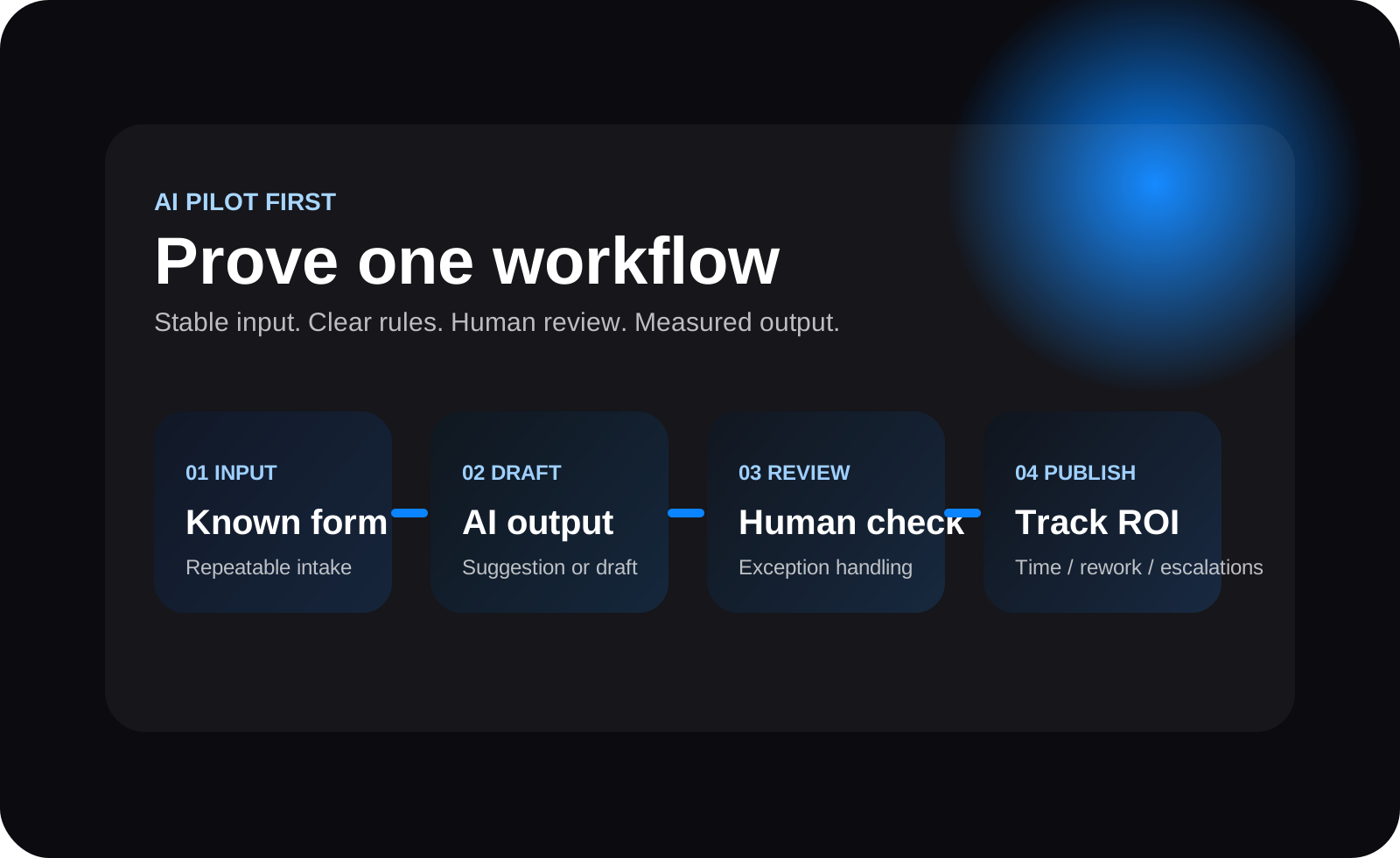
Look for three characteristics: high repetition, low exception variety, and obvious human-review points. Lead triage, knowledge-base drafting, support-reply suggestions, call summaries, and document classification all tend to perform better as first pilots than direct final-decision automation. These workflows already have a known input, a known output, and a clearer way to measure improvement.
What to measure during the pilot
Do not judge a pilot only by whether the output sounds fluent. Measure handling time, rework rate, escalation rate, and human takeover rate. If those metrics do not improve, the bottleneck is often not the model. It is usually the workflow boundary, data quality, or missing ownership. The urgency is also real: another NBER paper on adoption found that 23% of employed respondents had used generative AI for work in the previous week, and 9% used it every work day.
References
Continue to the Related Service
The service page most closely tied to this article is linked below so the insight and the commercial page reinforce the same topic cluster.
AI Systems Deployment
Deploy AI tools and AI agents into real workflows to reduce costs, improve speed, and raise execution quality.