
Build retrieval, permissions, and review before multi-agent automation
24 April 2026 · 7 min read
Most internal AI assistants fail not because the model is weak, but because source control, permission boundaries, and output checks were never designed first.
Article
Most internal AI assistants fail not because the model is weak, but because source control, permission boundaries, and output checks were never designed first.

IT Manager (Certified CISSP)
Mike is the IT Manager at Mayson AI with more than 8 years of experience in enterprise IT operations, AI deployment, and development. He specializes in applying modern technology to optimize business workflows and is committed to delivering highly reliable digital transformation solutions for enterprises.
Bottom line: for internal AI assistants, the safer deployment order is retrieval, permission isolation, and human review first, then multi-agent automation. Lewis and colleagues' RAG paper found that retrieval-augmented generation can produce more specific and factual output than parametric-only models. But once a system is connected to company knowledge, upside and risk scale together. Without evidence trails, access control, and output checks, the system becomes more capable and less governable at the same time.
Why retrieval should come before agent orchestration
If an answer has no source trail, business teams cannot tell whether it came from agreed internal knowledge or model guesswork. That is why RAG matters in enterprise deployment. Its value is not novelty. Its value is provenance. Tying answers back to approved documents makes updating, correcting, and auditing much easier than relying on a model's internal memory alone.
"more specific and factual output than parametric-only models"
Why permissions and review come before execution
NIST's AI RMF 1.0 says the framework exists to help organizations manage the many risks of AI while promoting trustworthy use. OWASP's 2025 guidance reinforces the same point from a security angle: prompt injection, sensitive information disclosure, and vector or embedding weaknesses are core LLM-application risks. In practice, the most common business failure is not weak prompting. It is the wrong user seeing the wrong answer, or an untrusted document quietly poisoning retrieval.
A steadier deployment order
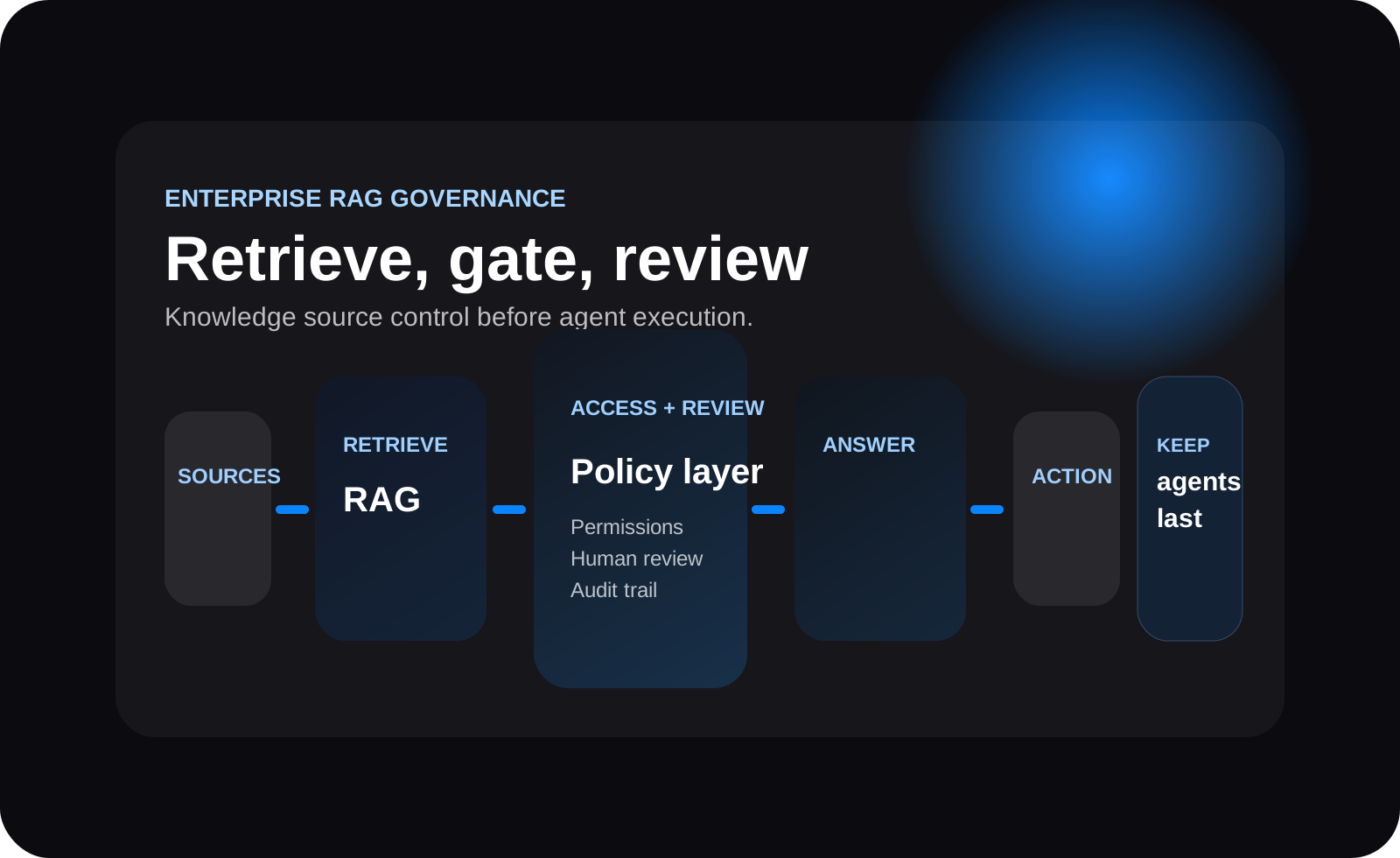
A steadier order is usually four steps. First, define an approved knowledge-source whitelist. Second, classify documents and implement permission-aware retrieval. Third, keep human review on high-risk outputs. Only after those layers are stable should you connect agents to approvals, actions, or downstream systems. Businesses do not need the AI that sounds smartest. They need the AI that is easiest to inspect and hardest to misuse.
Continue to the Related Service
The service page most closely tied to this article is linked below so the insight and the commercial page reinforce the same topic cluster.
AI Systems Deployment
Deploy AI tools and AI agents into real workflows to reduce costs, improve speed, and raise execution quality.
AI Workflow Automation
Connect the tools your team already uses and reduce repetitive handoffs.